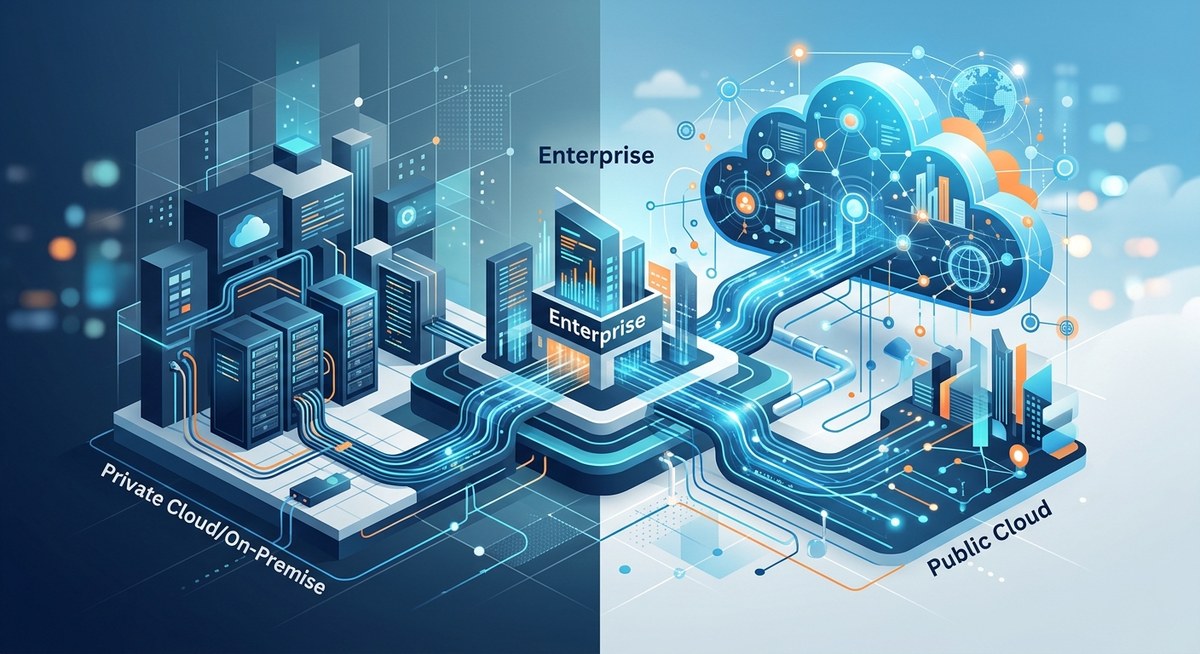
In today’s enterprise landscape, hybrid cloud is more than a hosting choice — it is an operational model. The most successful organizations blend private, public, and on premise resources to meet performance, security, and compliance goals while staying agile. At Spagic, we help you learn the art and science of integration across time zones, identities, devices, and systems. This guide dives into practical, middleware aware strategies to design, implement, and optimize hybrid cloud architectures that empower your teams and accelerate innovation.
The Rise of Hybrid Cloud Solutions
Hybrid cloud has moved from a niche option to a standard approach for modern enterprises. The core idea is simple, but the implications are broad: orchestrate workloads across multiple environments to achieve the right balance of cost, control, and capability.
Understanding Hybrid Cloud
- A hybrid cloud blends private and public cloud environments with on premises infrastructure.
- It integrates data, applications, and workloads so they can move between environments with minimal disruption.
- It emphasizes interoperability, governance, and security across clouds and devices.
Why Hybrid Cloud?
- Flexibility: Run workloads where they fit best, whether due to latency, data gravity, or regulatory requirements.
- Resilience: Avoid single points of failure by distributing workloads across regions and platforms.
- Cost optimization: Use scale economics of public clouds for burst workloads while keeping stable core services on private or dedicated infrastructure.
- Innovation velocity: Leverage cloud-native services and edge capabilities without overhauling existing systems.
As you read this, picture your organization not as a collection of silos but as a distributed mesh of services, with middleware at the center coordinating data, events, and identities across time zones and environments.
Optimizing Network Infrastructure with Hybrid Cloud
A strong network foundation makes or breaks a hybrid strategy. You need reliable connectivity, predictable performance, and robust security.
Network Flexibility and Scalability
- Adopt software defined networking (SDN) and software defined wide area networking (SD-WAN) to route traffic dynamically between clouds and on premises.
- Use interoperable VPNs and direct interconnects to reduce latency and improve throughput for critical workflows.
- Implement data gravity aware routing so that workloads and data stay where they perform best, and migrate when requirements shift.
Enhanced Performance and Reliability
- Place latency sensitive services closer to end users with edge deployments and regional gateways.
- Use caching layers, content delivery networks, and asynchronous messaging to decouple microservices and reduce response times.
- Build fault isolation with multi-region deployments, automated failover, and proven backup strategies.
Security and Compliance
- Enforce consistent encryption in transit and at rest across all environments.
- Apply identity and access management (IAM) policies uniformly, so permissions behave the same whether workloads run in private data centers or public clouds.
- Align with regulatory standards through data residency controls, auditing, and policy enforcement.
As you design the network, map service dependencies carefully. Middleware plays a central role in stitching disparate systems together while preserving security and observability.
Managed Services Providers: Your Partner in Hybrid Cloud Solutions
Managed services providers (MSPs) can accelerate your journey by offering expertise, tooling, and ongoing governance.
The Role of MSPs
- Provide architectural guidance tailored to your industry and workloads.
- Deliver monitoring, incident response, and change management across environments.
- Offer pre-built connectors and templates to reduce integration time.
Customized Cloud Solutions
- MSPs can help you assemble a hybrid stack that aligns with your business outcomes, from data integration to API management.
- They can tailor deployment models to fit regulatory needs and cross-region data flows.
Expertise and Support
- Ongoing optimization: cost management, performance tuning, and security posture reviews.
- Change management: ensuring migrations and updates do not disrupt business operations.
- Training and enablement: empowering your teams with the skills to manage hybrid ecosystems.
A thoughtful MSP partnership is not about outsourcing all control, but about amplifying internal capabilities with specialized discipline and scalable processes.
Implementing Hybrid Cloud Strategies
A structured approach reduces risk and speeds time to value. The following stages reflect practical patterns for larger enterprises seeking sustainable hybrid cloud adoption.
Assessment and Planning
- Inventory workloads and data: classify by sensitivity, latency requirements, and business importance.
- Define business use cases: identify where hybrid control adds value, such as disaster recovery, analytics, or regulatory compliance.
- Map dependencies: document how services interconnect across environments.
- Establish governance: create policies for data residency, encryption, identity, and access control.
- Determine success metrics: set targets for cost, performance, and reliability.
- Build a lightweight operating model: define ownership, incident response, and change control.
Integration and Migration
- Choose the right migration pattern: lift and shift, rehost, refactor, or new build.
- Prioritize workloads: start with low risk, high impact items to prove value quickly.
- Plan data movement carefully: consider synchronization frequency, consistency models, and bandwidth usage.
- Implement integration patterns: API gateways, event-driven architecture, message queues, and data streaming.
- Create testing and validation gates: performance, security, and compliance checks before production.
- Establish rollback and recovery strategies: ensure you can revert if issues arise.
Ongoing Management and Optimization
- Continuous monitoring: correlate performance with business outcomes, not only technical metrics.
- Cost governance: tag resources, use budgets, and optimize reserved capacity and spot instances where suitable.
- Security posture: maintain patching, vulnerability scanning, and IAM reviews across all environments.
- Compliance assurance: automated policy enforcement and regular audits.
- Evolutionary planning: revisit workloads as new cloud services and edge capabilities emerge.
- Training and enablement: keep teams up to date with middleware integration patterns and best practices.
A successful hybrid cloud program requires discipline in planning, disciplined execution, and a culture open to continuous improvement.
Special Topics for Modern Enterprises
Beyond general strategy, several specialized topics deserve focused attention to ensure your hybrid cloud is practical, scalable, and secure.
Cross Time Zone Scheduling in Hybrid Cloud Environments
- Shift aware workflows: design cron jobs and ETL pipelines that trigger based on target time zones to simplify reports and operations.
- Use time zone aware scheduling services: coordinate batch jobs so end users in different regions receive consistent experiences.
- Consider daylight saving time changes: implement dynamic offset handling to avoid missed runs or duplicated tasks.
- Align calendars with service level agreements (SLAs): ensure maintenance windows do not conflict with critical business hours globally.
- Build resilient event-driven patterns: reduce reliance on exact wall clock times by decoupling producers and consumers through durable queues and event streams.
Practical tip: centralize scheduling logic in middleware that can translate time zones and coordinate across cloud boundaries, rather than embedding time calculations in every service.
Federated Identity Management and IAM
- Federated identity enables users to authenticate across clouds with a single set of credentials.
- Use standards like SAML 2.0, OpenID Connect (OIDC), and OAuth 2.0 to connect identity providers (IdPs) with cloud services.
- Implement a hub and spoke model: a central IdP coordinates authentication for multiple cloud tenants and on premise systems.
- Enforce least privilege across environments with consistent role-based access control (RBAC) and attribute-based access control (ABAC).
- Audit and monitor authentication events across clouds to detect anomalies and ensure compliance.
In practice, federated identity reduces credential sprawl and supports a true hybrid workflow where developers and operators access tools across platforms using familiar identities.
LDAP Authentication in Hybrid Cloud Scenarios
- LDAP can serve as a core directory for on premise systems while cloud services adopt federated identities or synchronize with LDAP-compatible directories.
- Use secure LDAP (LDAPS) or encryption in transit to protect directory data during authentication.
- Bridge LDAP to cloud IAM through adapters or directory synchronization services, ensuring user attributes and group memberships stay in sync.
- Implement periodic reconciliations and reconciliation policies to maintain consistency as users join, move, or leave roles.
- Plan for scale: design directory replication and partitioning to handle growing user bases while maintaining performance.
LDAP remains a reliable backbone for enterprise identity when combined with modern cloud IAM and federation.
IoT Integration Across Hybrid Clouds
- Edge devices can push data to on premises gateways or directly into cloud data lakes, depending on latency and bandwidth constraints.
- Use a robust IoT platform that supports edge computing, secure device identity, and streaming pipelines to multiple clouds.
- Ensure secure provisioning and firmware updates for devices, with strong authentication and authorization at the edge.
- Establish data governance for IoT streams, including data labeling, lineage, and retention policies.
- Integrate IoT data with enterprise data platforms to drive analytics, AI, and real-time decision making.
IoT integration across hybrid environments amplifies insights but requires careful security, device management, and data flow design.
Security, Compliance, and Data Governance
- Implement a unified security model that spans clouds and on premise, including consistent policy enforcement and auditing.
- Use encryption in transit and at rest for all data, regardless of location.
- Maintain data residency controls and governance policies to satisfy regulatory demands and customer expectations.
- Regularly test security controls, including identity, network segmentation, and data protection measures.
- Establish incident response playbooks that cover cross-cloud incidents and coordinate with MSPs if used.
A strong governance framework allows you to innovate with confidence in a hybrid setting.
Costs and ROI
- Track total cost of ownership across environments, including storage, compute, networking, and data transfer.
- Apply cost optimization strategies such as right sizing, autoscaling, and opportunistic use of lower cost regions.
- Align cloud investments with business outcomes, using measurable ROI from faster time to market, improved reliability, and reduced downtime.
- Use cost transparency tools and dashboards to empower teams to make informed trade offs.
A data driven cost strategy keeps the hybrid program sustainable and aligned with corporate goals.
Final Thoughts
Hybrid cloud is not a destination but a continuous journey of optimization and learning. The most successful strategies tie together people, processes, and technology. They place middleware at the center of integration across time zones, identities, devices, and data. By combining careful assessment, disciplined migration, and proactive governance, your organization can reap the full benefits of hybrid cloud while maintaining security, compliance, and performance.
At Spagic, we believe in practical, hands on education for middleware and integration practitioners. This guide is designed to help you design modern hybrid cloud architectures that are not only technically sound but also easy to operate. Remember to start small, prove value quickly, and scale steadily as you refine your patterns and tooling. With the right approach, hybrid cloud becomes a powerful engine for enterprise innovation.
If you are building cross time zone scheduling, federated identity integration, LDAP driven authentication, or IoT connectivity into your hybrid model, you are not alone. Our tutorials and practical examples can help your teams master the middleware layers that connect clouds, devices, and users in a cohesive, secure, and high performing way.
Key takeaways:
– Hybrid cloud offers flexibility, resilience, and cost optimization when designed with governance and security in mind.
– A strong network foundation and middleware driven integration are essential for reliable cross environment operations.
– Federated identity and LDAP integration provide scalable, secure access across clouds and on premise systems.
– IoT integration in hybrid environments unlocks real time data and intelligent automation, with guardrails for security and governance.
– Ongoing management and optimization are critical to sustain value and adapt to new cloud services.
Starting your journey with a clear plan, stakeholder alignment, and a focus on middleware integration will help you realize the full potential of hybrid cloud for your enterprise.
Table of contents overview:
– The Rise of Hybrid Cloud Solutions
– Optimizing Network Infrastructure with Hybrid Cloud
– Managed Services Providers in Hybrid Cloud
– Implementing Hybrid Cloud Strategies
– Special Topics: Cross Time Zone Scheduling, Federated Identity, LDAP, IoT
– Security, Governance, and Costs
– Final Thoughts
Would you like a concrete, step by step starter plan for a typical mid sized enterprise? We can tailor an initial 90 day plan with milestones, responsibilities, and a sample tech stack aligned to your industry and compliance needs.